Here's what probably happened
Your partner said something like, "I was thinking we could maybe try using a toy together?" and suddenly your brain did a backflip. Maybe you felt a flash of inadequacy. Maybe you panicked that they're bored with you. Maybe you worried it means something's wrong with what you already do. All of that is normal. Almost none of it is true.
Let me be direct: when a partner brings toys into the conversation, they're not rejecting you. They're inviting you into something new. The uncertainty you're feeling right now? That's just the gap between the fantasy version of spontaneous, toy-free sex your culture sold you and the actual reality of real pleasure with a real person. The gap closes faster than you think.
What's actually going on in their head
I work with couples constantly around this exact moment, and here's what I hear from the partner who suggests toys: they want more pleasure for you. Not because they think you're broken. Because they've noticed something you might not have noticed about yourself yet. Maybe your arousal takes longer to build. Maybe you tense up in certain ways. Maybe you've mentioned before that things feel good but inconsistent. They watched that and thought, 'What if there's a tool that could help?'
That's not criticism. That's attention.
The other thing I hear? They're nervous too. People don't casually mention toys without rehearsing it first. They've already imagined you saying no, them feeling rejected, the whole thing becoming awkward. When your partner suggests this, they're already emotionally exposed. If you respond with openness instead of defensiveness, you're actually deepening intimacy. You're showing them it's safe to want something new with you.
Why uncertainty makes sense (and why it passes)
You've probably internalized some version of the myth that 'good sex' happens naturally, without props or planning or communication. That myth is toxic because it makes any deviation feel like failure. Adding a tool doesn't mean your body failed. It means you're both smart enough to use leverage.
Your uncertainty might also be rooted in a real concern: what if I don't like it? What if it feels weird? What if it kills the mood? Fair questions. The answer is: you try it in the lowest-pressure way possible, and you stay curious instead of self-conscious.
The real barrier isn't the toy, it's the story
Most people bring toys into a relationship and then obsess about whether it will "ruin" something. But the thing that actually ruins intimacy is shame. The toy doesn't. Your willingness to try something slightly outside your comfort zone because your partner wants to share it with you? That's the opposite of ruin.
Here's what usually happens in the first 20 minutes of using a lemon clitoral vibrator with a partner: it feels a little awkward. Your brain is busy noticing the sound, the sensation, the fact that you're doing something new. Then, after that adjustment period, your nervous system settles. Your partner's enthusiasm becomes the frame you're inside. You start paying attention to what actually feels good instead of what you think should feel good. And suddenly the awkwardness dissolves because pleasure is real and concrete and it's happening to you, right now.
How to actually have this conversation
Don't wait for the perfect moment. Have it soon, while you're not in the bedroom. Tell your partner: "I was nervous when you brought up toys, but I've been thinking about it and I want to try. I'm curious what you had in mind." That's it. Honest, moving forward, collaborative.
Then ask for specifics. Do they want to use it on you, or do they want you to use it on yourself while they watch? Do they want it integrated into foreplay or as the main event? These aren't weird clinical questions. They're how you move from general anxiety to a concrete plan. Concrete plans are less scary.
Starting with lemon clitoral vibrators (a practical note)
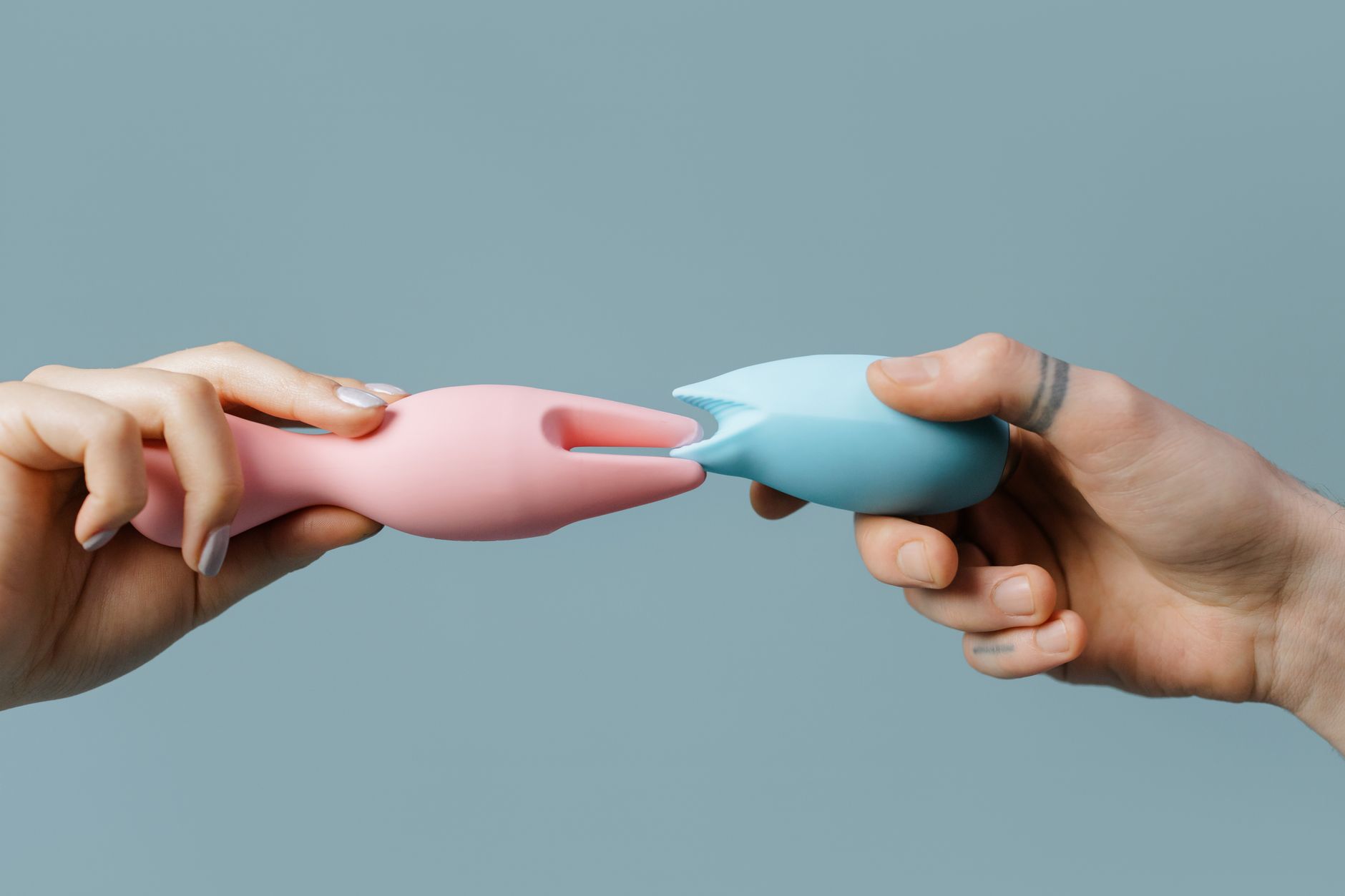
Lemon clitoral vibrators work particularly well in this scenario because they're not intimidating to look at. They don't feel like you're introducing something clinical or industrial into your intimate space. They work through suction, which means the sensation is different from direct vibration. That difference is usually good when you're nervous. It feels novel without feeling invasive. And they're effective fast, which means you're not spending 30 minutes wondering if you picked the right toy. You're spending time connected to your partner.
Start at a lower setting. Let your partner handle the pacing if you want to. The goal your first time is not your best orgasm ever. The goal is comfort with the idea that toys can live in your bedroom without ruining anything.
What happens after that first time
Something shifts. You realize you didn't die of embarrassment. The intimacy didn't evaporate. If anything, your partner's enthusiasm about wanting to please you in a new way probably felt good. And now that the box is open, it stays open. You might use it again. You might not use it for months. But you know it's there, and more importantly, you know your partner cares enough about your pleasure to suggest ways to deepen it.
That's not weakness. That's partnership.
When your partner says, "I don't need this, I just want you"
If your partner's suggestion feels conditional (like, "If we don't use toys I'll be disappointed"), that's a different conversation and worth addressing directly. But most of the time, when someone suggests a lemon vibrator or any clitoral vibrator, they're saying: I want you to feel as good as possible, and I'm willing to be curious alongside you. If that lands badly, it's usually because shame got there first.
Shame is the real problem. Not the toy.
The practical setup that matters most
Use a water-based lubricant. Lemon clitoral vibrators work best when the suction can seal properly, and lube helps that. It also makes everything feel less clinical and more sensual. You're not using lube because something's wrong. You're using it because you're being intentional.
Start with your clothes on if you want to. You don't have to go full intimacy mode the first time. You can explore the sensation while you're both still mostly dressed, just curious. That takes pressure off.
Turn your phone off. Tell yourself you have 15 minutes, not forever. Artificial time constraints actually help with performance anxiety because your brain stops scanning for 'is this working yet.' You're just inside 15 minutes of trying something new together.
What changes after you say yes
Your relationship doesn't transform because you tried a toy. But something does shift. You proved to your partner that you're willing to grow with them. You proved to yourself that pleasure is worth being a little uncomfortable. And you silently told your partner: I trust you enough to be vulnerable about trying something that scares me. That's the real intimacy. The toy is just the vehicle.
Honestly? Most couples report that introducing any lemon sexual toy into their routine doesn't change the frequency of sex, but it changes the quality. It changes how seen they feel. It changes the conversation from 'we're having sex' to 'we're both committed to each other's pleasure.' And that matters more than any technique ever will.
FAQ: When your partner wants to try toys
What if I try it and I hate it?
You put it down and you don't use it again. Your partner gets to know that. You get to know that. No permanent damage, no obligation to keep going. The goal is exploration, not forced enthusiasm. If it genuinely doesn't work for you, say that. A good partner responds with, 'Okay, what would feel better?' not shame.
Does using a toy mean my partner finds me boring?
No. It means your partner finds you worth investing in. They're not bored. They're interested. There's a meaningful difference. When someone suggests a lemon clitoral vibrator or any sex toy, they're saying 'I like you enough to want more for you,' not 'you're not enough.' Your insecurity is telling you the second story. Don't believe it.
What if I have an orgasm with the toy and didn't expect to?
Then you just had an orgasm with your partner, which is the whole point. Surprise pleasure is still pleasure. You don't need to apologize for it or make sense of it. You can just enjoy it. And you can tell your partner it felt good if you want to, which usually leads to a very nice conversation about doing it again.
Can I use a lemon vibrator solo and then with my partner?
Absolutely. In fact, many people feel less self-conscious the second time they use any clitoral vibrator because they already know how their body responds to it. You can explore it alone first, figure out what settings feel good, and then invite your partner in when you feel ready. That's actually a smart move.
What if my partner wants to use the toy more often than I do?
That's a rhythm negotiation, not a crisis. You talk about it. Maybe you use it once a week. Maybe you use it twice. Maybe you use it only on weekends. You figure out what feels sustainable for both of you. This is already a more honest conversation than a lot of couples ever have about sex, so you're winning.
What if I feel self-conscious about my partner watching?
Start with the lights dimmed or off entirely. Start with your partner not watching but just being present. You can graduate to more eye contact after you know how your body feels with the toy. Self-consciousness usually dissolves once pleasure becomes real. Give it permission to take a few tries.
The closing
Your uncertainty right now is not a sign to back away. It's a sign that something real is trying to happen between you and your partner. Real things are sometimes uncomfortable at first. But discomfort isn't the same as danger. You're not risking anything by trying a lemon clitoral vibrator with your partner. You're risking something by staying stuck in shame about what pleasure could look like together.
If you want more specific guidance on talking to your partner about this or navigating other relationship transitions, reach out. That's what I'm here for.